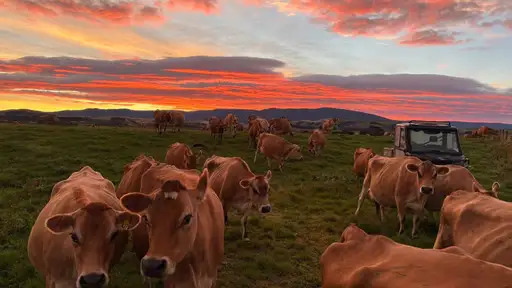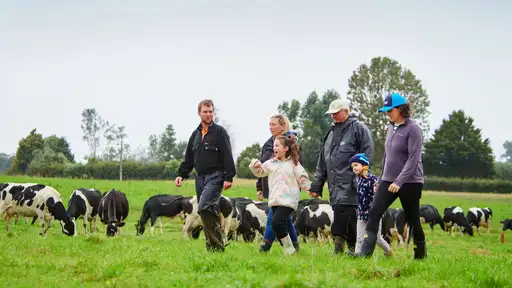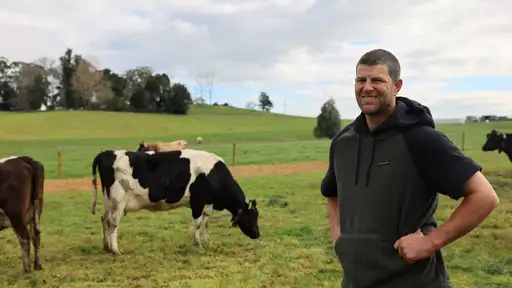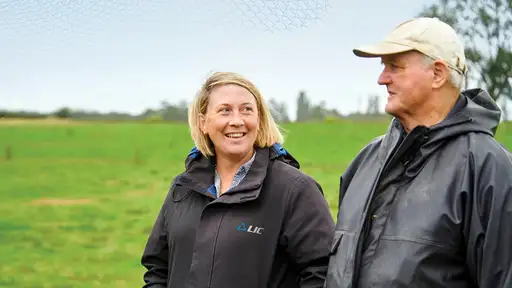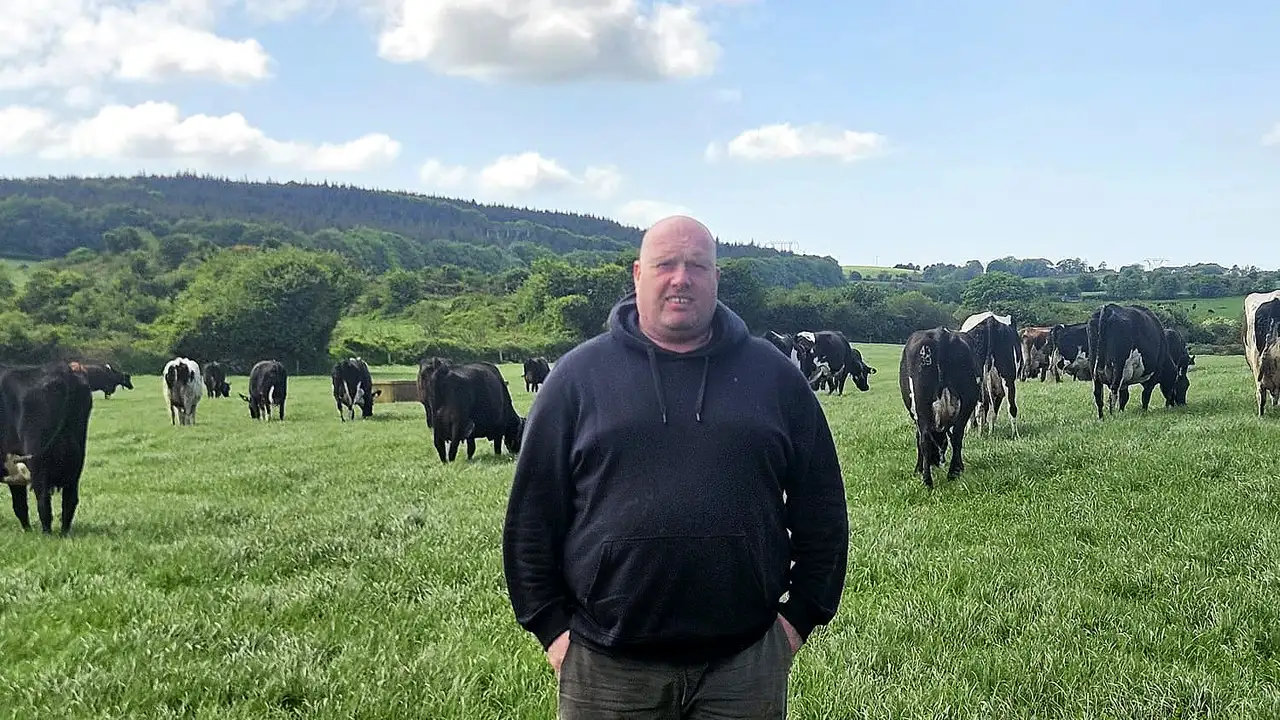
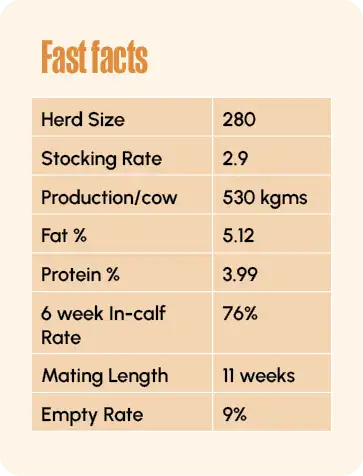
Milking 280 predominantly crossbred cows, John's approach is built around moderate-sized, highly fertile animals that convert grass into milksolids efficiently. It’s a system he has refined over more than 20 years on the family farm, alongside his wife Siobhan, their children and wider family.
That long-term thinking now underpins every breeding decision on the farm.
Today, the entire herd is run through a structured mating programme. The top 60% of cows, along with all heifers, are bred to sexed semen for the first three weeks, with the remainder going straight to dairy beef. From week four onwards, all cows are mated to beef, tightening the calving pattern and adding value to non-replacement stock.
From winter milk to a spring system
When John returned home from agricultural college in 1999, the farm looked very different. At the time, it operated a winter milking system focused on volume.
“We were paid on litres, not solids,” he says. “You could roll cows from one season to the next.”
But as Ireland moved towards seasonal spring calving, fertility became a pain point, with empty rates climbing into the high teens and mating periods stretching out to 15 or 16 weeks.
“Fertility was a big issue. Once rolling cows stopped, we had to solve that problem.”
John says the solution wasn’t a quick fix, it was a rethink of their breeding strategy.
“You’re hoping to get eight or nine lactations out of a cow. So, a wrong decision can live with you for a long time.”
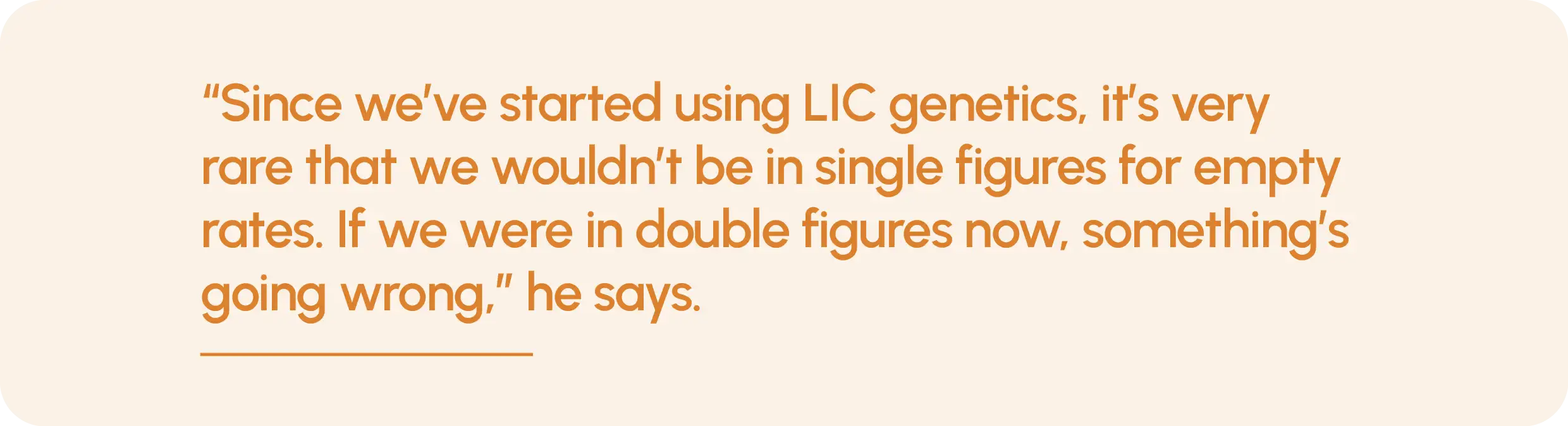
Breeding seasons have tightened to 10–11 weeks, with John now disappointed if empty rates creep above 10%.
A turning point: Kiwi genetics
While carrying out AB work on other farms, John noticed some herds using New Zealand genetics. Curious, he decided to try a small amount over his own herd.
“I saw a bull called Hugo in an LIC catalogue. He looked balanced, so I gave him a go.”
What began as a small trial quickly grew. Jerseys, Norwegian Red and Friesian crosses followed, and when the first crossbred heifers calved, the difference was obvious.
“I remember looking at them and thinking, ‘Geez, I’ve missed a trick here.’ They were giving us everything we wanted.”
By the mid 2000s, John had committed fully to crossbreeding, replacing a large proportion of his herd with crossbred heifers.
Adapting to a changing environment
Today, John milks 280 cows across two farms, stocked at around 2.9 cows per hectare - which is a deliberate step back from higher stocking rates.
“We were up around 3.6 cows per hectare at one point. But the summers have changed. We could have two months in the summer where we might have to start feeding silage, which can get expensive.”
More frequent droughts have reduced grass growth from 14–16 tonnes, to closer to 10–12 tonnes annually. On the farm’s dry, shallow soils, that shift has real consequences.
“It dries out very quickly here, so you have to match your stocking rate, and your cow, to that.”
That’s where KiwiCross genetics continue to prove their worth.
“Solaris is one of the first KiwiCross bulls we used, and they were just brilliant stock. I couldn't say enough good things about them. Since then, we’ve been trying to keep the cows somewhere in the middle of the road. If one gets too Friesian, we’ll put a Jersey on her, and vice versa.”
Smaller cows, more output
The move to KiwiCross genetics has delivered gains well beyond fertility.
Calving ease, animal health and milk composition have all improved significantly.
“About 97% of the herd calves
unassisted. It’s a very healthy
system.”
John says milk quality has also lifted, with averages now exceeding 5% fat and close to 4% protein, levels that were out of reach in the old system.
“We would never have seen that with the black and white cows we had before. You’d have days in spring where you were struggling to hit 3% protein.”
At the same time, cow size has reduced dramatically. The herd now averages 480–490kg liveweight, more than 100kg lighter than previous generations, while producing around 530kg of milksolids per cow.
“They’re a very efficient cow for their size.”
At one point, John admits, he had a “speed wobble” - briefly stepping away from his LIC programme.
“I used Irish sired bulls on some of the cows, and when those cows calved, I was disappointed straight away because there was no uniformity. Some were big, some were small, they were everywhere.”
Two years later, when those animals entered the milking herd, the gap widened.
“They were easily standing 70 or 80 kilos heavier as heifers, than our LIC bred counterparts. And I’d say in 90% of cases, they produced less.”
John is quick to point out it’s not a criticism of Irish genetics, but rather the system they’re bred for.
“A lot of those bulls come from herds that are housed for long periods and heavily fed. Their figures look great, but it’s a different environment.”
For his grazing system, he says, the fit simply wasn’t there. “The LIC bulls seem to be more tapered towards the proper grazing cow.”
“That was probably the only speed wobble I ever had, and it only lasted about five minutes. I knew straight away I’d made a mistake.”
The proof is in the pudding
John says some farmers who followed a similar breeding path and made the same detour are now seeing the consequences.
“There are other local farmers who have followed the same breeding programme as ourselves for years,” he says. “They probably had the same speed wobble, but let it last longer.”
“The production has dropped on their systems, trying to do the same thing as us, and a lot of those guys are back using LIC genetics again.”
“The proof is in the pudding. I'm very happy with what we have at the moment. The selection of bulls is excellent. For obvious reasons, I keep going back because I like what I have. All I’d say is, keep the good bulls coming.”